Conference starts in -1203 days

Educational sessions – Friday 30 October 2026
TRACK A: Designing Transparent and Reproducible Real-World Drug Studies
(More suitable for beginners/intermediate)
This track introduces core pharmacoepidemiologic study designs and the strengths and limitations of major real-world data sources. With a focus on transparency, reproducibility, and emerging AI-assisted approaches, participants will gain hands-on skills in prompt engineering for protocol development, statistical analysis in SAS and R, and effective data visualization for pharmacoepidemiologic research.

Dr Celine SL Chui
Dr Celine SL Chui
Celine SL Chui, PhD, is an Assistant Professor at the University of Hong Kong, with international experience at the London School of Hygiene & Tropical Medicine and City St George’s, University of London. Her research uses real-world evidence, knowledge translation, and implementation science to improve population health, including major work in vaccine safety surveillance, neurological and mental health epidemiology, and AI-enabled cardiovascular risk prediction. She has published more than 150 peer-reviewed articles in leading journals including The Lancet Infectious Diseases, BMJ, JAMA Internal Medicine, npj Digital Medicine, and Neurology. She has received multiple awards and recognitions, including the International Society for Pharmacoepidemiology Emerging Leader Award.

Dr Franco Cheng
Dr Fanco Chen
Dr Franco Cheng is a pharmacoepidemiologist at the University of Auckland School of Pharmacy. He brings broad clinical experience across cardiology, nephrology, critical care, and respiratory medicine from Hong Kong hospitals, and is Board-Certified in both Pharmacotherapy and Cardiology Pharmacy. His research applies large-scale health data to medicines safety, cardiovascular and renal outcomes, and vaccine effectiveness, including COVID-19 vaccine safety

Jack Chi-Him Lau
Jack Chi-him Lau
Jack Chi-him LAU is a 3rd-year PhD candidate in Pharmacoepidemiology at the University of Hong Kong. Jack's core research leverages extensive electronic healthcare records (EHRs) to analyze infectious disease epidemiology and antimicrobial resistance (AMR) trends —a critical global health threat.

Eunice Kehui
Eunice Kehui
Eunice is a PhD student in pharmacoepidemiology and a pharmacist by training, with strong interdisciplinary expertise in pharmacy and epidemiology. She is a highly diligent and motivated investigator who has contributed to multiple collaborative projects, resulting in high-quality peer-reviewed publications. Her work spans medication safety, outcomes research, and the application of large healthcare databases to inform clinical and policy decision-making. Known for her strong analytical skills and attention to methodological rigor, she consistently strives to produce research with meaningful clinical impact.
Beyond her academic achievements, Eunice has demonstrated outstanding leadership and professional service. She is the founding Vice President of the ISPE Student Chapter (Hong Kong), where she has actively fostered student engagement and professional development in pharmacoepidemiology. She also served on the Local Organising Committee for the 2025 Asian Conference, contributing to the successful coordination of this major regional scientific meeting.

Dr George Tan
Dr George Tan
George Tan, BPharm (Hons), PhD is an Adjunct Research Fellow at the Centre for Medicine Use and Safety (CMUS), Faculty of Pharmacy and Pharmaceutical Sciences, Monash University. George supports grant and contract-funded pharmacoepidemiology projects, as well as supervises PhD students. His primary research focus is on using real-world data to advance drug repurposing, particularly in implementing novel data-driven methodologies to generate drug-outcome signals, and using target trial emulation to validate candidate signals. Previously serving as a Research Fellow at CMUS, George managed data governance, ethics and access to large healthcare datasets hosted in CMUS. He is also part of the Neurological and Mental Health Global Epidemiology Network (NeuroGEN). Currently, he is a Market Access professional in a global medical technology company. George is also a practising pharmacist and serves as a Pharmacy Board of Australia examiner. George currently serves as the Chair of the Australasian Society of Clinical and Experimental Pharmacologists and Toxicologists Pharmacoepidemiology Special Interest Group, co-leading initiatives that build capacity and visibility of pharmacoepidemiology research in Australia.
Edward Chun Yin Lau
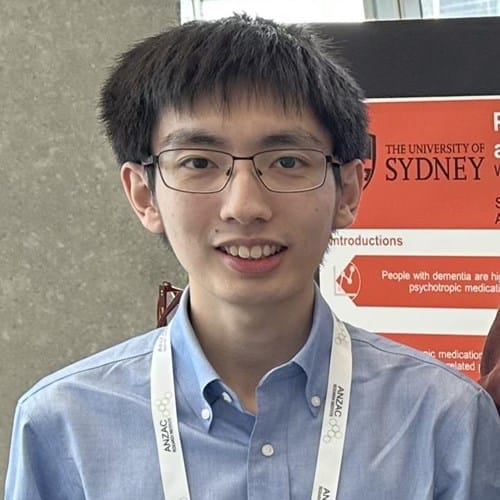
Edward Chun Yin Lau
Edward is a community pharmacist in Australia and PhD student at the University of Sydney with a research interest in pharmacoepidemiology in older people, especially people living with dementia in community settings in Australia. He is particularly interested in the prevalence, risk factors and outcomes of high-risk prescribing in this population. His research is aimed at improving the safety and effectiveness of medication use in people living with dementia.

Dr Mary Beth Ritchey
Krishna Undela
Jack Chi-him LAU is a 3rd-year PhD candidate in Pharmacoepidemiology at the University of Hong Kong. Jack's core research leverages extensive electronic healthcare records (EHRs) to analyze infectious disease epidemiology and antimicrobial resistance (AMR) trends —a critical global health threat.
Dr Benjamin Daniels
Krishna Undela
Eunice is a PhD student in pharmacoepidemiology and a pharmacist by training, with strong interdisciplinary expertise in pharmacy and epidemiology. She is a highly diligent and motivated investigator who has contributed to multiple collaborative projects, resulting in high-quality peer-reviewed publications. Her work spans medication safety, outcomes research, and the application of large healthcare databases to inform clinical and policy decision-making. Known for her strong analytical skills and attention to methodological rigor, she consistently strives to produce research with meaningful clinical impact.
Beyond her academic achievements, Eunice has demonstrated outstanding leadership and professional service. She is the founding Vice President of the ISPE Student Chapter (Hong Kong), where she has actively fostered student engagement and professional development in pharmacoepidemiology. She also served on the Local Organising Committee for the 2025 Asian Conference, contributing to the successful coordination of this major regional scientific meeting.
TRACK B: Emulating a Hypothetical Drug Trial Using Real-World Data
(More suitable for advanced)
This advanced track provides an in-depth introduction to advanced target trial emulation methods, covering database integration and optimization, clone–censor–weighting, and sequential trial-based designs. Through practical exercises and real-world examples, participants will engage in an interactive, hands-on learning experience to develop practical skills in applying these advanced methods to real-world research.

A/Prof Joshua Lin
A/Prof Joshua Lin
Joshua Lin, MD ScD, is a practicing internist, Associate Professor at Harvard Medical School, Executive Director of the Center for Integrated Healthcare Data Research, and Director of the Program of Optimal and Safe Prescribing in the Elderly (PROSPER) in Mass General Brigham Integrated Health Care System, Boston. As Principal Investigator, he has led multiple large U.S. national studies to optimize drug safety and effectiveness in vulnerable populations using target trial emulation when randomized trials are not feasible. His work extensively advances causal inference using AI combined with electronic health records and administrative claims data.

Dr Daniel Tsai
Dr Daniel Tsai
Daniel Tsai is a doctoral research fellow at Population Health Data Center, NCKU. He specializes in comparative effectiveness research and policy research. His expertise includes triangulating claims databases, electronic health records, and biomedical databases to inform causal inference. Additionally, he is actively involved in the intersection of artificial intelligence and geriatric medicine. Moreover, Daniel serves as an educational co-lead of the Asian Pharmacoepidemiology Network (AsPEN) and is an active member of the Neurological and Mental Health Global Epidemiology Network (NeuroGEN), where he contributes to fostering international research collaboration and advancing pharmacoepidemiology.

Dr Nathan Vidal
Dr Nathan Vidal
I am Nathan Vidal, PhD, currently a postdoctoral fellow at the National Cheng Kung University in Tainan, Taiwan. My research topics of interest include mental health epidemiology, the adverse effects of psychotropic medications and cognitive disorders. I have experience working with a wide range of methods, from frequentist methods such as case-crossover designs, to data-driven network analyses or deep learning models, with the utlitmate goal of using real-world evidence to guide treatment management. My studies extensively relied on mental healthcare registries, the French or the Taiwanese claims databases. My background in biology and cognitive science drives my interest in studying cognitive health and characterizing its contributing factors. I am also dedicated to promoting healthcare for vulnerable populations with complex healthcare trajectories, such as individuals with disabilities or people who are incarcerated.

Dr Kenneth Mann
Dr Kenneth Mann
Dr Kenneth K.C. Man is a pharmacoepidemiologist and medical statistician at UCL School of Pharmacy. His research uses large-scale routinely collected healthcare data to evaluate medication safety and effectiveness, with a particular focus on self-controlled designs and other causal inference approaches for observational data. His applied work centres on psychiatric, paediatric and perinatal pharmacoepidemiology, and he has led international multi-database studies of medicines used in children, in pregnancy and by people with mental health conditions. He chairs the CPRD Expert Review Committee and serves on the central advisory committee for CPRD.
Dr Kenneth Mann
Joshua Lin
Dr Kenneth K.C. Man is a pharmacoepidemiologist and medical statistician at UCL School of Pharmacy. His research uses large-scale routinely collected healthcare data to evaluate medication safety and effectiveness, with a particular focus on self-controlled designs and other causal inference approaches for observational data. His applied work centres on psychiatric, paediatric and perinatal pharmacoepidemiology, and he has led international multi-database studies of medicines used in children, in pregnancy and by people with mental health conditions. He chairs the CPRD Expert Review Committee and serves on the central advisory committee for CPRD.

Dr Wallis Lau
Dr Wallis Lau
Dr Wallis Lau is a Lecturer in Pharmacoepidemiology and Drug Safety at UCL School of Pharmacy. With a background in statistics and a PhD in pharmacoepidemiology, her research uses large electronic healthcare databases to investigate the safety and effectiveness of medicines. Her research interests include cardiovascular, neurological and mental health conditions, and she has extensive experience applying real-world evidence and advanced pharmacoepidemiological methods to clinically important medication-safety questions.
TRACK C: Machine Learning in Real-World Drug Studies: Introduction to Prediction and Natural Language Processing (NLP) models
This track introduces machine learning-based prediction modelling and NLP applications in real-world drug studies. Participants will gain practical exposure to basic coding workflows, machine learning–driven disease phenotyping strategies, while learning to critically evaluate epidemiologic biases in NLP-enhanced analyses.

Dr Yanmin Zhu
Dr Yanmin Zhu
Yanmin Zhu, PhD, is an Assistant Professor in the Division of Pharmacoepidemiology and Pharmacoeconomics at Brigham and Women’s Hospital and Harvard Medical School. Her research focuses on using real-world data, including healthcare claims and electronic health records, to study the determinants of maternal and newborn health. She has led work on machine learning approaches for gestational age estimation and on large language model methods for outcome phenotyping. Her current research aims to develop practical and reproducible ML/LLM-guided frameworks to generate real-world evidence and strengthen clinical research using structured and unstructured data.

Dr Richeek Pradhan
Dr Richeek Pradhan
Richeek Pradhan, MD PhD, is a Lecturer at the Centre for Medicine Use and Safety, Monash University, with training in clinical pharmacology, epidemiology, health informatics, and pharmacoepidemiology. His research uses real-world data and causal inference methods to study medication safety, effectiveness, and potential new uses of existing medicines. He has also worked on natural language processing approaches to identify social determinants of health, characterize medication discontinuation from electronic health records, and strengthen drug safety surveillance using structured and unstructured clinical data. His work spans antihyperglycemic agents, cancer, liver disease, chronic obstructive pulmonary disease, ageing, and medication safety, with publications in journals including BMJ, Diabetes Care, Gut, and JAMIA.

Dr Harvey Koh
Dr Harvey Koh
Dr Harvey Jia Wei Koh is a postdoctoral research fellow and lead of Digital Pharmacoepidemiology within the Pharmacoepidemiology Research Group at Monash University's School of Public Health and Preventive Medicine. His work focuses on developing novel explainable Bayesian machine learning and trajectory mining methods for pharmacoepidemiology. An interdisciplinary researcher with publications in leading journals such as Nature Digital Medicine, Dr Koh leads a translational research programme spanning applied machine learning, health informatics, and artificial intelligence. He holds a joint affiliation with the Faculty of Information Technology and maintains active collaborations with major health services, professional bodies, and national research consortia.

Dr Ting Xia
Dr Ting Xia
Dr Ting Xia is a Research Fellow with Monash Addiction Research Centre at Monash University with a focus on the use of linked primary health data and hospital data to evaluate the impact of policy changes on opioid prescribing. She has a Bachelor of Preventive Medicine, a Master of Toxicology, and a PhD in Public Health. Prior to her PhD, Dr Xia worked as public health physician at the Nanjing Center for Disease Control and Prevention in China. After completing her PhD, she provides statistical and research expertise on a number of multi-disciplinary projects and supervises Honours, Masters and PhD students.
Dr Kenneth Mann
Joshua Lin
Dr Kenneth K.C. Man is a pharmacoepidemiologist and medical statistician at UCL School of Pharmacy. His research uses large-scale routinely collected healthcare data to evaluate medication safety and effectiveness, with a particular focus on self-controlled designs and other causal inference approaches for observational data. His applied work centres on psychiatric, paediatric and perinatal pharmacoepidemiology, and he has led international multi-database studies of medicines used in children, in pregnancy and by people with mental health conditions. He chairs the CPRD Expert Review Committee and serves on the central advisory committee for CPRD.

Crystal Leung
Crystal Leung
Crystal Leung is a Research Officer at the Monash Addiction Research Centre. She recently graduated with a Master’s in Health Data Analytics as the top-performing student of her cohort. Her research focuses on developing Natural Language Processing (NLP) and Machine Learning (ML) pipelines to improve the surveillance of opioid overdoses in Victoria. She has quantitative experience in time-series analysis and breakpoint analysis, with a focus on identifying trends in opioid overdoses in Victoria. Her broader research interests include the use of Artificial Intelligence (AI) to strengthen public health surveillance and data-driven interventions for drug harms. She is interested in pursuing a PhD in this area.
TRACK D: Learning from Real-World Evidence to Inform Policy and Practice
This policy-focused track examines how real-world drug studies inform regulatory processes, reimbursement decisions in Australia and globally, and using real world data for health economic evaluations of drugs. Participants will understand how evidence is translated into policy and funding decisions.

Prof Zanfina Ademi
Prof Zanfina Ademi
Professor Zanfina Ademi is an internationally recognised health economist whose work focuses on generating economic evidence to inform healthcare policy, reimbursement and resource allocation. She is Professor of Health Economics and Head of the Health Economics and Policy Evaluation Research (HEPER) Group in the Faculty of Pharmacy and Pharmaceutical Sciences at Monash University, Australia, and holds visiting professorships at the University of Eastern Finland and the University of Prishtina.
Her expertise spans economic evaluation, health technology assessment and decision modelling, with a strong focus on prevention and screening. She developed the Productivity-Adjusted Life Year (PALY), a metric that captures the impact of health on work productivity. A Fellow of the Higher Education Academy, she teaches pharmacoeconomics to pharmacy students and is committed to building health economics capability among healthcare professionals.
Professor Ademi has authored more than 260 peer-reviewed publications and has secured over AUD 50 million in research funding. She was identified in a global bibliometric analysis as one of the two most productive authors in healthcare cost-effectiveness research from 2013 to 2023. She has led the health economics of health technology assessments for the Swiss Medical Board and served as a member of Australia's PBAC Economics Sub-Committee, contributing to national reimbursement decisions.
is an internationally recognised health economist whose work focuses on generating economic evidence to inform healthcare policy, reimbursement and resource allocation. She is Professor of Health Economics and Head of the Health Economics and Policy Evaluation Research (HEPER) Group in the Faculty of Pharmacy and Pharmaceutical Sciences at Monash University, Australia, and holds visiting professorships at the University of Eastern Finland and the University of Prishtina.
Her expertise spans economic evaluation, health technology assessment and decision modelling, with a strong focus on prevention and screening. She developed the Productivity-Adjusted Life Year (PALY), a metric that captures the impact of health on work productivity. A Fellow of the Higher Education Academy, she teaches pharmacoeconomics to pharmacy students and is committed to building health economics capability among healthcare professionals.
Professor Ademi has authored more than 260 peer-reviewed publications and has secured over AUD 50 million in research funding. She was identified in a global bibliometric analysis as one of the two most productive authors in healthcare cost-effectiveness research from 2013 to 2023. She has led the health economics of health technology assessments for the Swiss Medical Board and served as a member of Australia's PBAC Economics Sub-Committee, contributing to national reimbursement decisions.

Dr Gopisankar Mohanannair Geethadevi
Dr Gopisankar Mohanannair Geethadevi
Gopisankar, MD, PhD, is a research fellow at the Centre for Medicine Use and Safety, Monash University, with training in medicine, pharmacology, pharmacoepidemiology and pharmacoeconomics. His work focuses on developing health economic models that simulate the real world as closely as possible, using data from various sources such as clinical trials and real-world databases. He is an advanced SAS-certified modeler with hands-on experience in machine learning methods, which he has used to develop prediction models for dementia and cognitive impairment. His work spans epilepsy, cancer, chronic obstructive pulmonary disease, ageing and medication safety, with publications in journals including Neurology, the Cochrane Database of Systematic Reviews and Epilepsia.
Dr Melanie Lloyd
Zanfina Ademi
Zanfina Ademi, PhD, is Professor of Health Economics at Monash University and founding head of the Health Economics and Policy Evaluation Research Group. Trained as a pharmacist, epidemiologist, and health economist, her work sits at the intersection of real-world evidence, health economics, reimbursement, and policy translation. She serves on the Economics Sub Committee of the Pharmaceutical Benefits Advisory Committee (PBAC), supporting the evaluation of medicines for Pharmaceutical Benefits Scheme listing in Australia. Her research has informed national and international policy decisions across medicines, vaccines, genomic testing, cardiovascular and kidney disease, and Alzheimer’s therapies, with publications in journals including NEJM, BMJ, The Lancet, JAMA, Diabetes Care, PharmacoEconomics, and Value in Health.
Prof Olaf Klungel
Zanfina Ademi
Zanfina Ademi, PhD, is Professor of Health Economics at Monash University and founding head of the Health Economics and Policy Evaluation Research Group. Trained as a pharmacist, epidemiologist, and health economist, her work sits at the intersection of real-world evidence, health economics, reimbursement, and policy translation. She serves on the Economics Sub Committee of the Pharmaceutical Benefits Advisory Committee (PBAC), supporting the evaluation of medicines for Pharmaceutical Benefits Scheme listing in Australia. Her research has informed national and international policy decisions across medicines, vaccines, genomic testing, cardiovascular and kidney disease, and Alzheimer’s therapies, with publications in journals including NEJM, BMJ, The Lancet, JAMA, Diabetes Care, PharmacoEconomics, and Value in Health.